Researchers Develop Reconfigurable mmWave Microchip for 6G
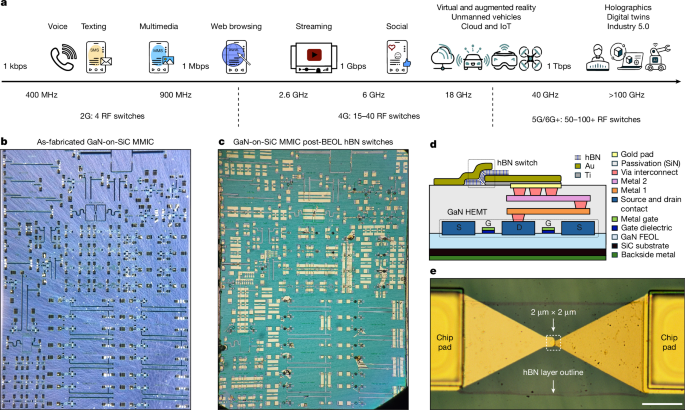
Researchers have developed a reconfigurable millimeter-wave (mmWave) microchip that integrates hexagonal boron nitride (hBN) switches on gallium nitride (GaN) substrates. This breakthrough, detailed in a recent publication, addresses key challenges in 6G wireless systems by enabling dynamic frequency tuning and improved signal integrity at high frequencies. The co-integration of hBN, a 2D material, with GaN allows for low-loss, high-speed switching essential for next-generation communications. The work builds on prior research into 6G vision, requirements, and opportunities, as cited from Tataria et al. (2021). The innovation could accelerate the development of 6G infrastructure, which promises terabit-per-second data rates and ultra-low latency. No official statements from the research team or industry partners were included in the provided content.
Global Impact
Technologically, this innovation is a critical enabler for 6G, which will underpin autonomous systems, holographic communications, and pervasive AI. Economically, it could unlock a multi-trillion-dollar market for 6G services and infrastructure by the early 2030s, with early movers capturing significant patent royalties.